
Pre-processing-system
Home » Pre-processing system
Pretreatment System
In a bottling line, the pretreatment system is a core upstream process that ensures product quality, safety, and stability. Its equipment combination varies depending on the product (such as juice, beverages, dairy products, wine, soy sauce, etc.).
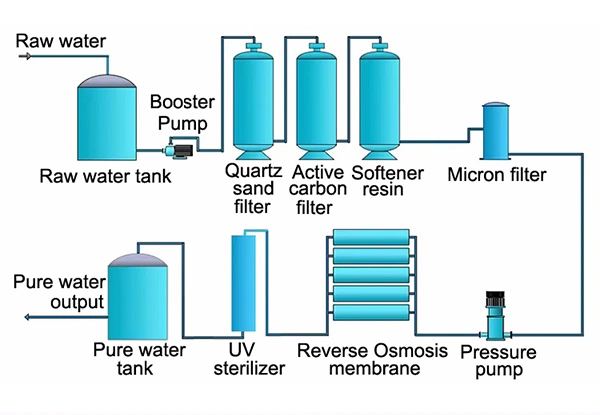
Water Production Pretreatment
Multi-media Filter: Removes suspended solids, colloids, sand, and silt from water.
Activated Carbon Filter: Adsorbs residual chlorine, organic matter, colors, and odors.
Water Softener (Sodium Ion Exchanger): Removes calcium and magnesium ions to prevent scaling.
Precision Filter / Cartridge Filter: Further removes micron-sized particles.
Reverse Osmosis (RO) / Nanofiltration (NF) / Electrodeionization (EDI) Unit: Deep desalination to produce purified or softened water.
UV Sterilizer / Ozone Generator / Aseptic Storage Tank: Provides final sterilization and aseptic storage for the treated water.
Batching & Mixing (Compounding) System
Sugar Dissolver / Syrup Tank:Equipped with heating and agitation to quickly dissolve solid ingredients such as sugar, salt, or other powders. It helps produce a clear and consistent syrup that can be pumped directly to the mixing section.
Mixing Tank / Batching Tank:A series of tanks with agitation and temperature control for mixing water, ingredients, sweeteners, acids, flavors, colors, and stabilizers. They ensure accurate dosing, uniform mixing, and consistent product quality during batching.
High-Shear Mixer / Pre-Homogenizer:Used during batching to achieve finer dispersion of ingredients, ensuring a more uniform and stable mixture. It effectively prevents separation, improves dissolution efficiency, and prepares the product for downstream processes like filtration, heating, or final homogenization.
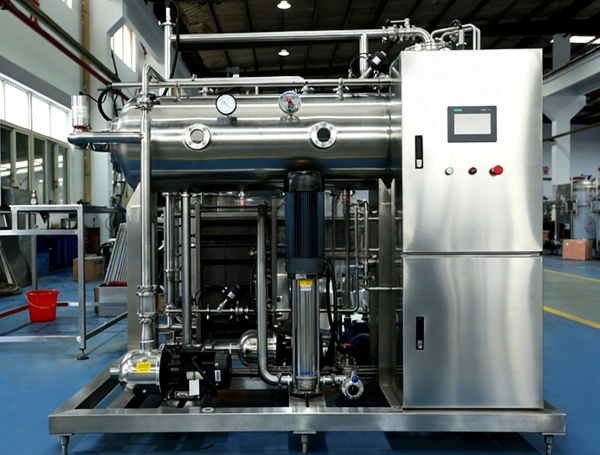
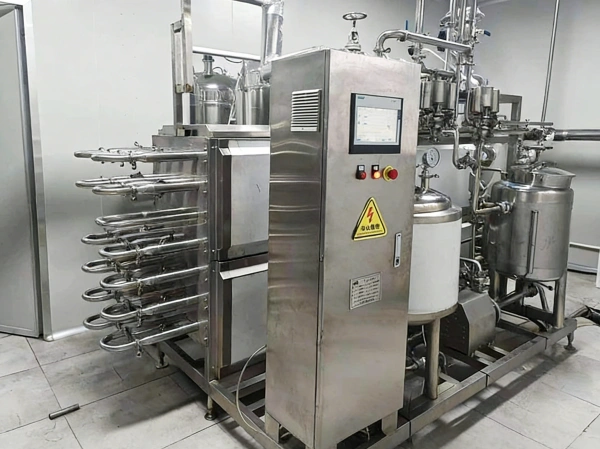
Heating & Sterilization System
Plate / Tubular Heat Exchanger:
Used for Pasteurization or HTST processing, providing fast heating and cooling. Plate type is suitable for low-viscosity beverages, while tubular type handles products with slight fiber or thicker texture.
UHT Sterilizer:
Used for Ultra-High Temperature (UHT) treatment for products such as milk and neutral beverages. It enables long shelf life and is typically paired with aseptic filling.
Shell & Tube / Scraped Surface Sterilizer:
Suitable for products with particles, pulp, or high viscosity. It prevents burning and ensures uniform heating, commonly used for yogurt drinks, jams, and beverages with particulates.
Deaeration & Homogenization Equipment
Vacuum Deaerator: The vacuum deaerator is designed to efficiently remove dissolved oxygen and other unwanted gases from beverages before filling. By operating under negative pressure, it allows entrapped air to escape from the liquid, significantly reducing oxidation reactions.
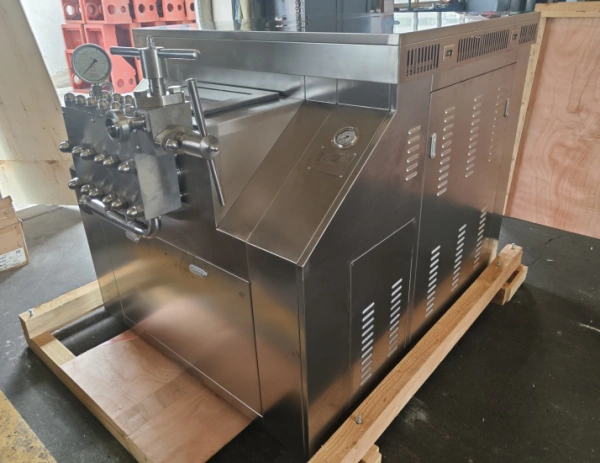
High-Pressure Homogenizer: The high-pressure homogenizer is typically used after heat sterilization and before final filling. It forces the product through a narrow gap at high pressure, breaking fat globules and particles into very fine sizes to form a uniform, stable emulsion.Homogenization also gives the product a smoother texture, better mouthfeel, a more attractive appearance, and longer shelf stability during transportation and storage.
Auxiliary & Support System Equipment
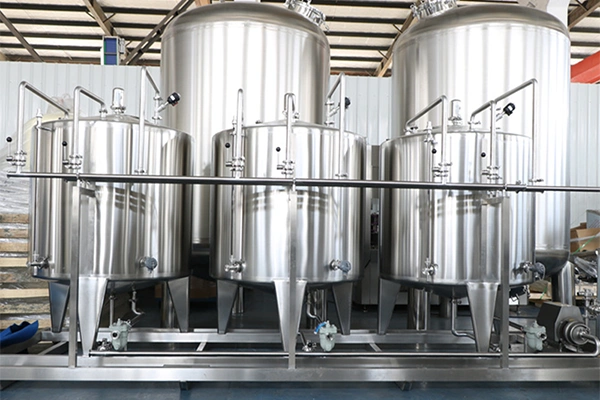
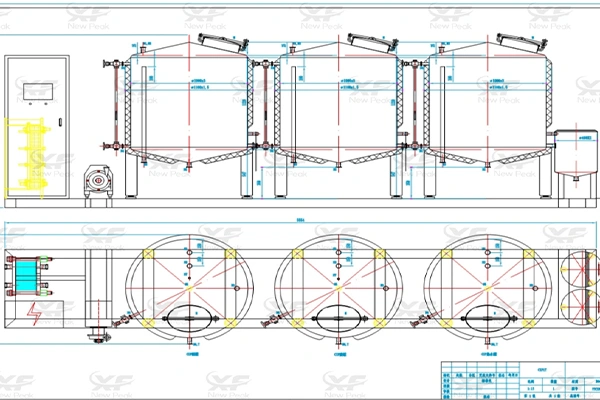
Conveyance & Buffer Storage Equipment:
Balance Tank / Buffer Tank: Buffers capacity differences between process stages to ensure continuous feeding.Aseptic Storage Tank (for UHT products): Stores sterilized product, ready for aseptic filling.
Product Transfer Pumps (Centrifugal, Lobe, Progressive Cavity, etc.): Connect various process stages to move the product.
Piping, Valves & Fittings: Constitute the complete fluid transfer system, including CIP circuit lines.
Cooler / Chiller: Rapidly cools the sterilized product to the required filling temperature (e.g., ambient or low temperature).
Chilled Water Unit / Refrigeration System: Provides coolant for the cooling process.
CIP System: The core sanitation system for pretreatment, including CIP supply pumps, acid/alkali tanks, hot water tank, heater, return pump, and automated control system. It automatically cleans and sanitizes the interiors of pipes, tanks, heat exchangers, etc., without disassembly.
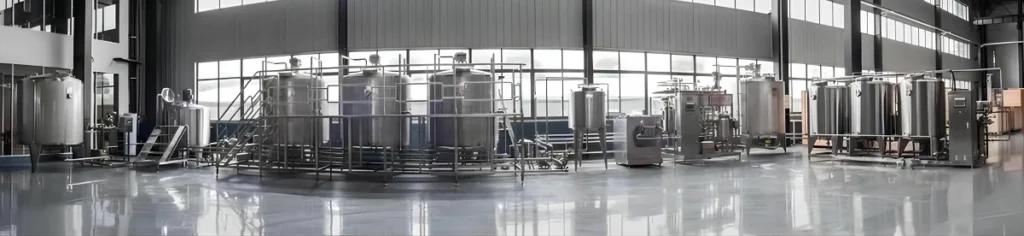
Typical Flow & Equipment Sequence (Example: UHT Juice/Dairy Beverage):
Raw Water → Water Treatment System (Purification, Softening, RO) → Aseptic Water Tank
↓
Sugar, Acid, Flavors, etc. → Batching System (Dissolver, Mixing Tanks) → Mixing
↓
Juice/Milk Base → Pretreatment (Filtration, Homogenization) → Mixing
↓
UHT Sterilizer (Heating → Holding → Cooling) → Aseptic Storage Tank → Aseptic Filler
In summary
The pretreatment system of a filling line is a comprehensive module that integrates physical treatment, chemical compounding, thermal sterilization, and precise homogenization.
Its main goal is to produce a ready-to-fill product that meets quality standards, remains uniform and stable, achieves commercial sterility, and is fully prepared for the filling process.
The specific equipment configuration depends on product characteristics, process requirements, production capacity, and the desired level of automation.
FAQ
Why must water be specially treated in the pretreatment system?
As a primary ingredient, untreated water containing minerals, microorganisms, and impurities can cause three major issues: 1) Product Spoilage (microbial contamination); 2) Poor Taste (off-flavors or high hardness); and 3) Equipment Damage (scaling and clogging pipelines). Therefore, water treatment is essential for ensuring product safety, consistent flavor, and stable equipment operation.
How to identify and resolve product separation or sedimentation before filling?
The issue is usually due to insufficient homogenization or improper mixing. Steps to resolve:
Identify the cause: Check if homogenizer pressure (15–25 MPa) meets standards and if emulsifiers/stabilizers were added correctly.
Corrective actions: Increase homogenization pressure and verify mixing speed and time for complete dissolution and dispersion.
Prevention: Regularly calibrate the homogenizer and follow standardized batching procedures.
What is the critical role of the vacuum deaerator in pretreatment?
1. Prevents oxidation: Maintains product color and vitamin content, and prevents flavor deterioration.
2. Avoids foaming during filling: Ensures accurate filling volume and secure sealing.
3. Reduces corrosion: Protects downstream pipelines and storage tanks. Its working principle involves pumping the product into a vacuum chamber to remove oxygen and other gases in a low-pressure environment.
How does a CIP system work, and how often should it be performed?
The standard cleaning process is as follows: hot water rinse → alkaline circulation (to remove grease) → hot water rinse → acidic circulation (to remove scale) → final rinse → disinfection. Cleaning frequency depends on the production schedule:
1. Inter-batch cleaning: Cleaning is required after each batch of production.
2. Daily cleaning: A more thorough cleaning is performed at the end of the production day.
3. Weekly/monthly cleaning: A more comprehensive cleaning is performed periodically.
When and under what conditions should UHT sterilization versus Pasteurization be chosen?
UHT Sterilization: For low-acid products (milk, soy) needing long shelf life and ambient storage; heats to 135–150°C for a few seconds.
Pasteurization: For acidic beverages (juice, yogurt) requiring flavor retention, cold storage, and shorter shelf life; heats to 72–95°C for tens of seconds.