
Water Treatment System
To guarantee the pure taste, consistent quality, and compliance with national safety standards for beverage products, production water must undergo deep purification.
Home » Water Treatment System
Water Quality Analysis and Solution Customization
To ensure the accuracy and cost-effectiveness of the system design, we require clients to provide a complete raw water quality analysis report (including key indicators such as pH, turbidity, total dissolved solids (TDS), total hardness, iron, manganese, organic matter (COD), residual chlorine, and total bacterial count). Our engineers will then tailor the treatment process and equipment parameters according to this report and your target product water quality requirements (such as conductivity, hardness, and microbial limits).
Detailed Core Process Flow & Equipment
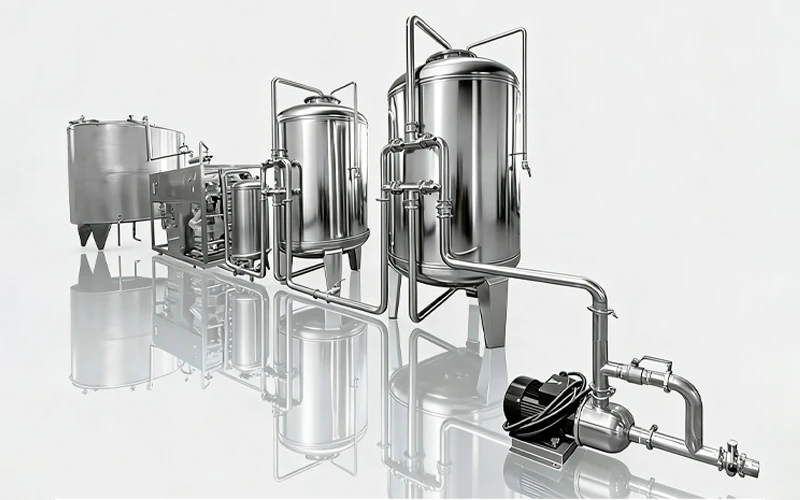
Raw Water Tank & Raw Water Pump
Function: The raw water tank stores incoming water, providing buffering and preliminary sedimentation. The raw water pump supplies the initial driving force for the entire system, steadily conveying raw water to subsequent pre-treatment units.
Key Control: Tank material is food-grade SUS304 stainless steel, equipped with a level controller for automatic start/stop interlock with the pump.
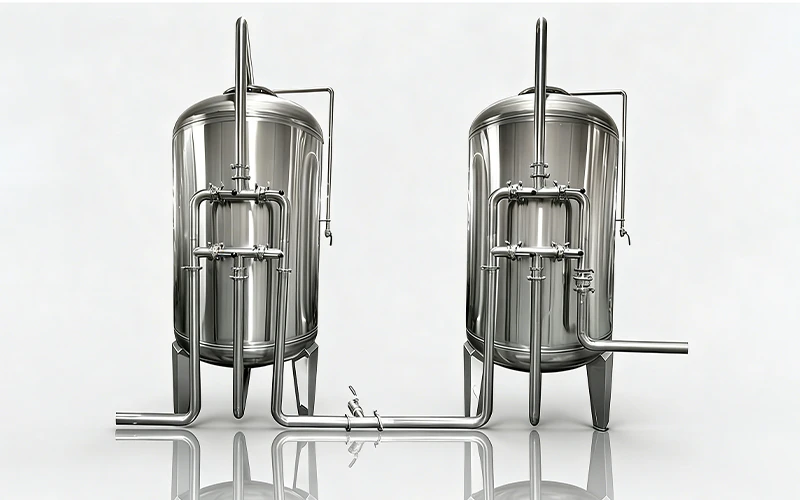
Quartz Sand Filter (Multi-media Filter)
Function: The core of the first-stage pre-treatment. Utilizes multiple layers of refined quartz sand to primarily remove suspended solids, sediment, rust, colloids, and particles larger than 20 microns from the water.
Treatment Efficacy: Effluent Turbidity < 0.5 NTU, Iron Content < 0.05 mg/L, Silt Density Index (SDI) ≤ 5. Effectively protects downstream equipment from clogging.
Technical Note: For source water with high turbidity or iron/manganese levels per the report, enhanced processes like aeration or manganese sand filtration can be considered.
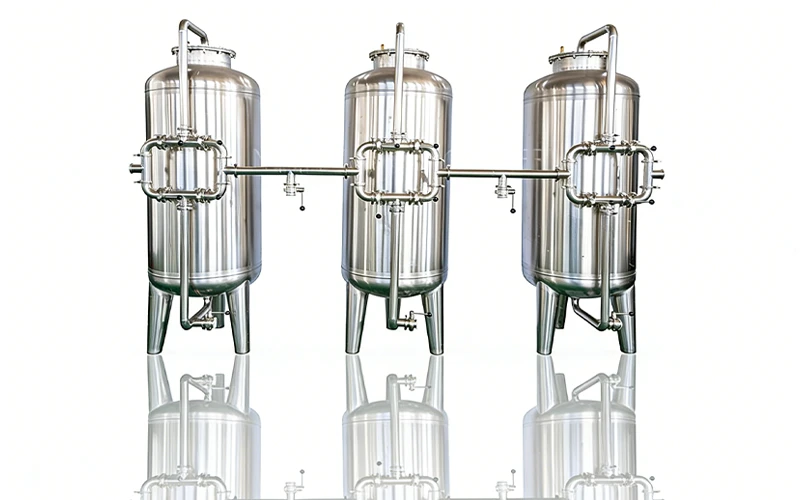
Activated Carbon Filter
Function: The core of the second-stage pre-treatment. Leverages the strong adsorption capacity of activated carbon to effectively remove color, odor, organic matter, residual chlorine, and some pesticide residues.
Treatment Efficacy: Residual chlorine removal > 99%, effluent residual chlorine ≤ 0.1 mg/L, protecting the chlorine-sensitive RO membranes downstream. Further reduces COD.
Technical Note: Surface functional groups on activated carbon also adsorb some heavy metal ions. Requires regular thermal sanitization or replacement to prevent microbial growth.
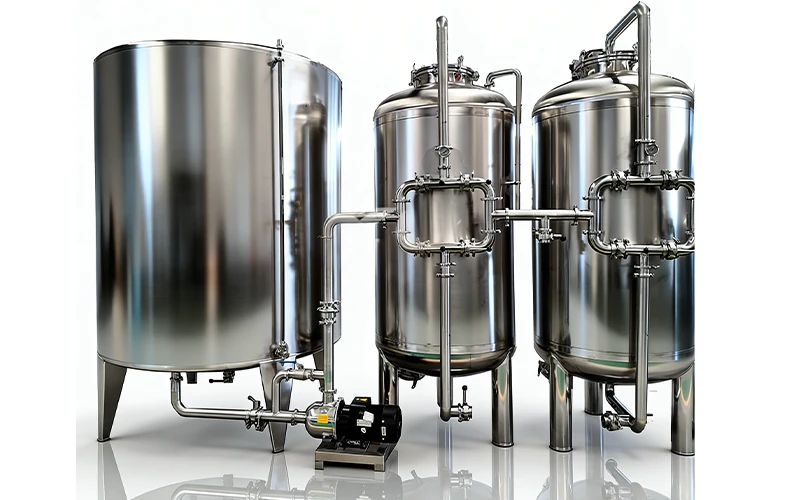
Sodium Ion Exchanger (Water Softener)
Function: Third-stage pre-treatment (for high-hardness water sources). Exchanges scale-forming ions like calcium (Ca²⁺) and magnesium (Mg²⁺) in the water for sodium ions (Na⁺) via cation exchange resin.
Treatment Efficacy: Significantly reduces total water hardness, often to very low levels (typically <1.5 mg/L), fundamentally preventing scaling on RO membranes and subsequent pipelines.
Technical Note: The system features a fully automatic regeneration device using brine to restore resin capacity for continuous operation. Activation of this unit depends entirely on the raw water hardness report.
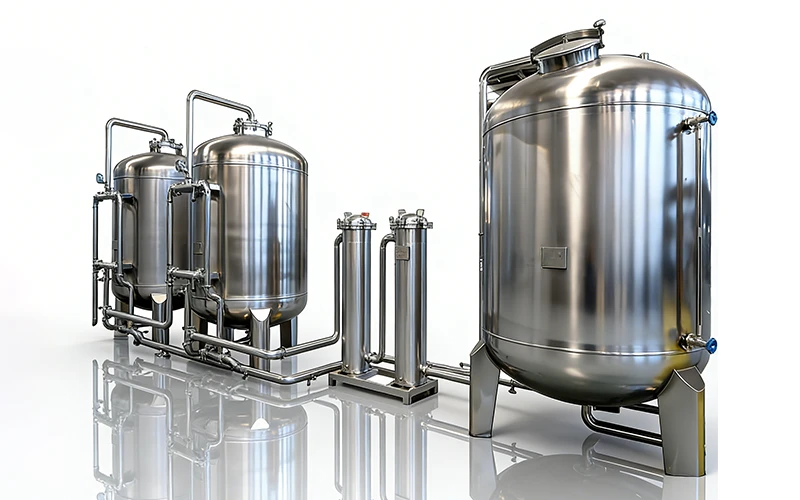
Precision Filter (Cartridge Filter / Safety Filter)
Function: The final pre-treatment barrier. Employs 5-micron or 1-micron filter cartridges to trap any fine particles, colloids, or carbon fines that may have passed through previous stages.
Treatment Efficacy: Ensures feed water to the RO membrane has particle size < 1 micron and meets SDI requirements, providing absolute safety for the RO membranes.
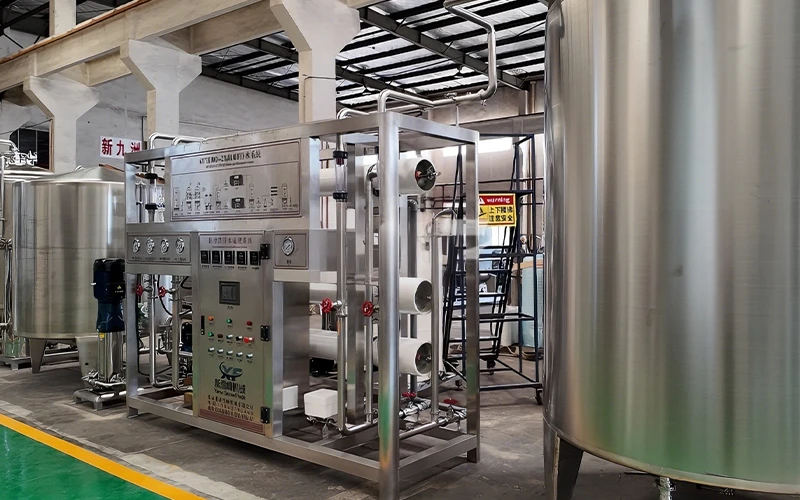
Intermediate Buffer Tank & High-Pressure Pump
Function: The buffer tank ensures a stable supply of pre-treated water. The high-pressure pump is the “heart” of the RO system, providing the necessary operating pressure (typically 6-15 bar) to overcome osmotic pressure and force water molecules through the membrane elements.
Key Control: Pumps are high-efficiency, energy-saving 304 or 316 stainless steel multi-stage centrifugal pumps, with interlocking protection for system pressure and flow.
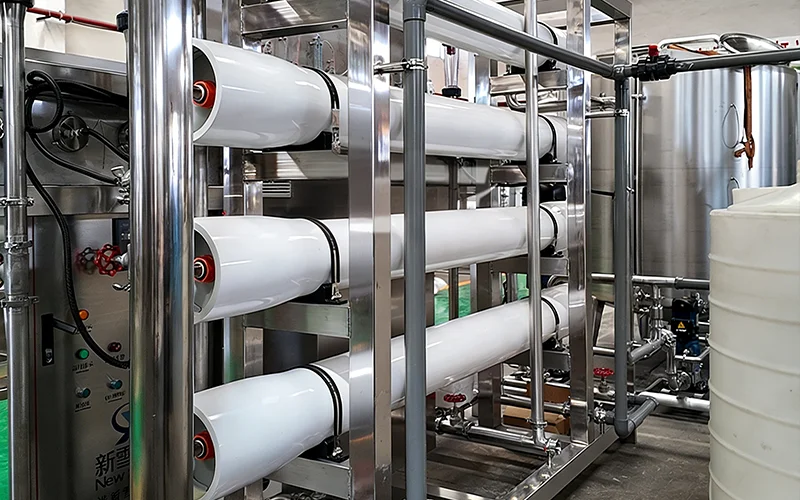
Reverse Osmosis (RO) System
- Function: The core unit for desalination and purification. Uses high pressure to force water molecules through a semi-permeable membrane with pores as small as 0.0001 microns, effectively rejecting dissolved salts, colloids, organics, bacteria, and viruses.
- Treatment Efficacy: Desalination rate >99%, removal rate for organics and microorganisms >99%. Product water conductivity can be stably below 10 μS/cm (depending on source water and membrane stages).
- Professional Configuration: Core membrane elements use renowned American brands (e.g., DOW/Hydranautics). Designed as single-stage or double-stage based on product water requirements. Equipped with automatic flush and Clean-In-Place (CIP) systems for long-term, stable membrane performance.
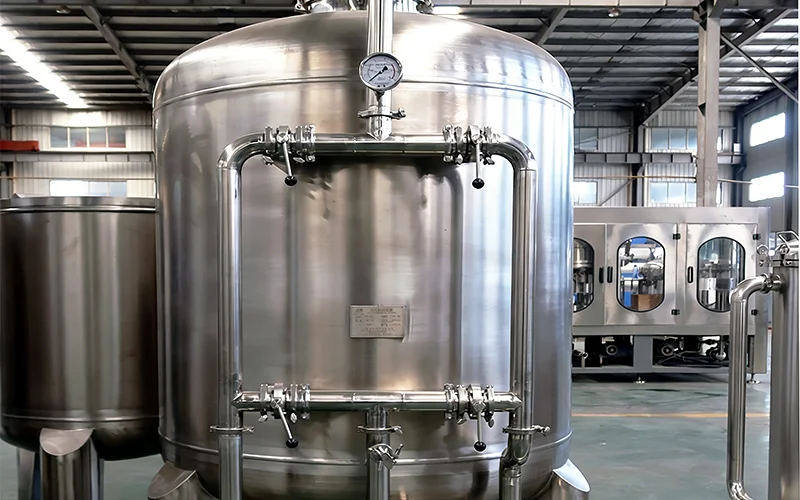
RO Product Water Storage Tank
Function: Stores the purified water from the RO system. Constructed of SUS304 stainless steel with polished interior, equipped with a vent filter (0.22μm air membrane) to prevent airborne contamination.
Technical Note: Tank design follows fluid dynamics to avoid dead zones and allows for thorough cleaning.
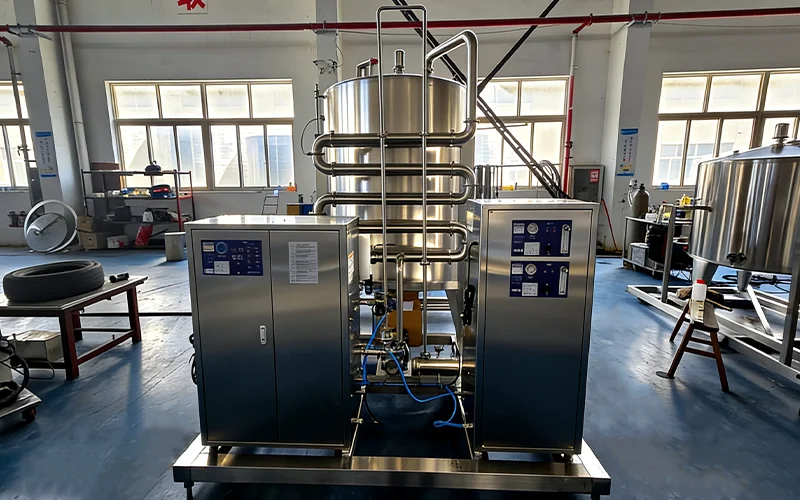
High-Efficiency Ozone Mixing Tower
Function: Final sterilization safeguard. Ozone (O₃) is a powerful oxidizing biocide. Through efficient contact in the mixing tower (constructed of corrosion-resistant SUS316), it kills any remaining bacteria and viruses in the water and decomposes trace organic matter.
Treatment Efficacy: Achieves sterile water supply while eliminating potential “off-tastes” and improving water palatability. Ozone decomposes to oxygen after its half-life, leaving no harmful residuals.
Technical Note: Can be used in conjunction with a UV sterilizer (before or after ozone) to form a dual-barrier disinfection system for higher safety levels.
Why Water Quality Report Matters?
Before designing every production line, we must obtain the Raw Water Quality Report because it directly determines the configuration of the water treatment system.
| Item | Impact | Corresponding Treatment Method |
|---|---|---|
| High Turbidity | Clogs filters | Strengthened sand filtration, coagulant dosing |
| High TDS | Single-stage RO is insufficient | Two-stage RO, add EDI |
| High Hardness | RO membrane scaling | Add water softener / antiscalant |
| High Residual Chlorine | Damages RO membrane | Activated carbon filtration or reducing agent |
| Excess Iron & Manganese | Fouling and blockage of membrane elements | Manganese sand / oxidation filtration |
| High COD | Organic pollution to RO membrane | Increase activated carbon or add UF |
| High Bacterial Count | Hygiene and safety risk | UV + Ozone sterilization |
This ensures our solutions precisely meet the required standards for pure water, mineral water, beverage processing water, and industrial purified water.